04 Proteins II Enzymes
Outline
4.1 Regarding enzymes
4.2 Enzymes increase reaction rate
4.3 The mechanism of an enzyme can be deduced from structural, kinetic, and spectral data
4.4 Examples of enzyme regulation
Learning Objectives
- Describe the general properties of enzymes using correct scientific vocabulary.
- Examine the rates of enzymatically catalyzed reactions mathematically.
- Construct reaction mechanisms for enzymatically catalyzed reactions based on experimental data.
- Compare the different means by which enzymes are regulated.
Section 4.1 Learning Objective
Describe the general properties of enzymes using correct scientific vocabulary.
Enzymes Defined
Enzymes are catalysts involved in biochemical reactions.
- Increase the rate of reaction
- Usually globular proteins
- Can be monomeric or multimeric
Topology of Enzymes
Figure 4.2 General topology of enzymes.

Substrate Defined
Substrate is a molecule (or molecules) that acts as the reactant in a enzymatically catalyzed reaction.
- More than 60% of biochemical reactions use multiple substrates.
- Binds to the enzyme at the active site
- When the enzyme binds to the substrate, product(s) is/are formed.
Active Site Defined
Active site is the location where the enzyme binds to the substrate and catalysis occurs.
- Located on the surface of the enzyme
- Is often in a cleft, pocket, or trench
- Generally formed by residues on turns or coils
Topology of Active Site
Figure 4.4 Topology of the active site.
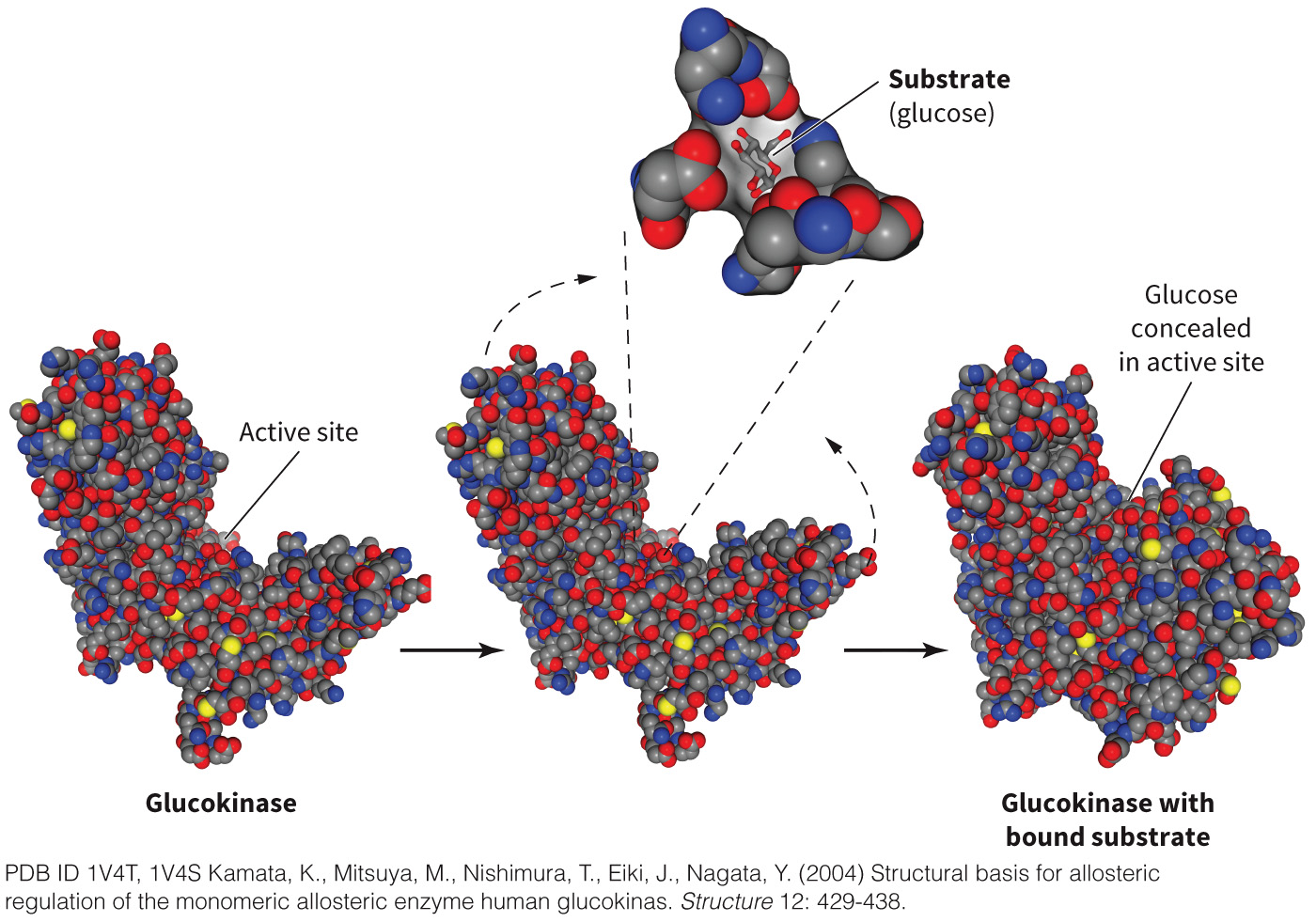
Enzyme–Substrate Binding Models
Lock and key
Figure 4.3A Models of substrate binding.
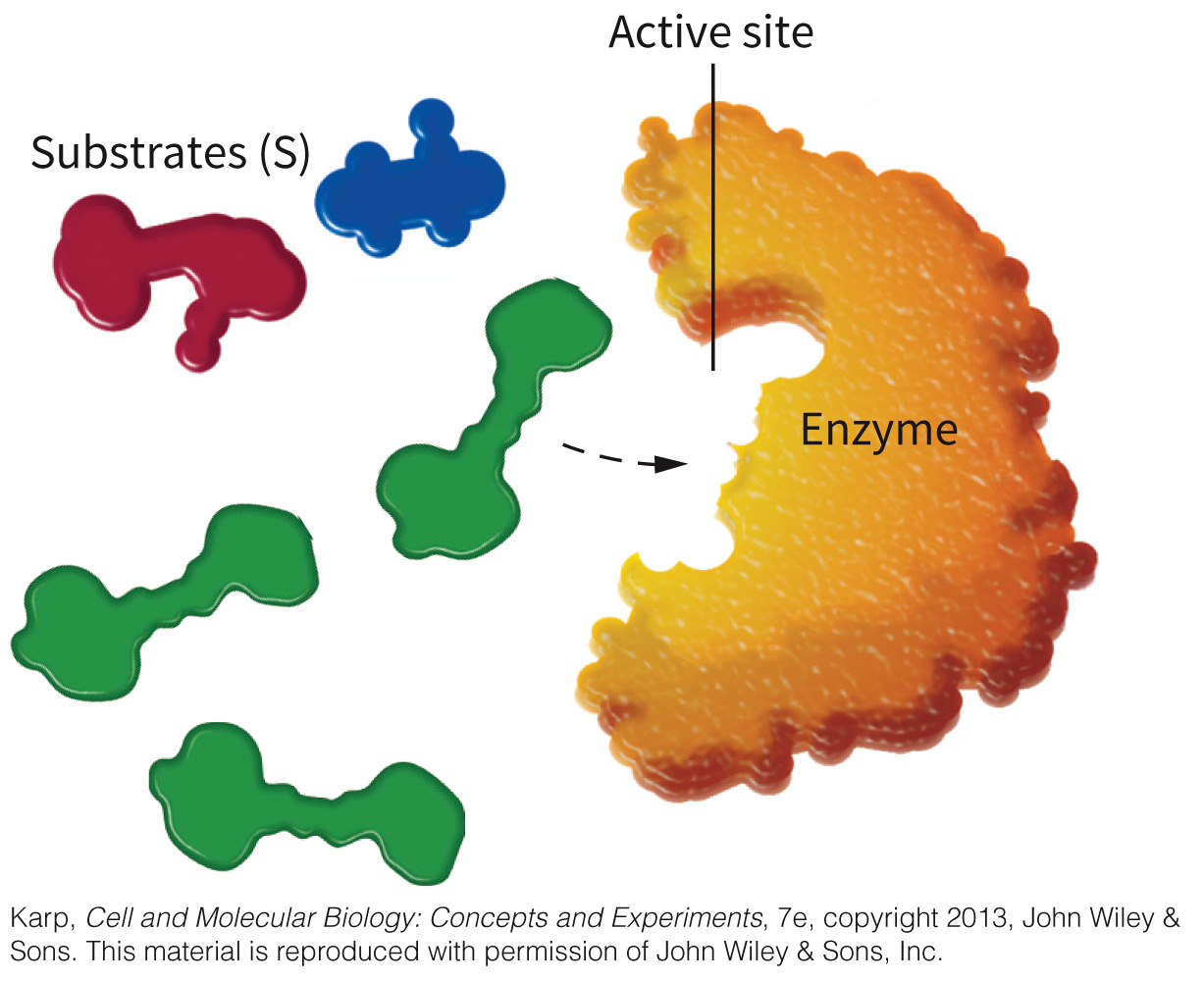
Enzyme–Substrate Binding Models
Induced fit
Figure 4.3B Models of substrate binding.

Enzyme Classifications
Oxidoreductases catalyze reactions involving the gain or loss of electrons
Transferases transfer one group to another
Hydrolases cleave a bond with water
Enzyme Classifications
Lyases break double bonds using some other means than oxidation or hydrolysis
Isomerases catalyze a rearrangement of the molecule
Ligases join two molecules
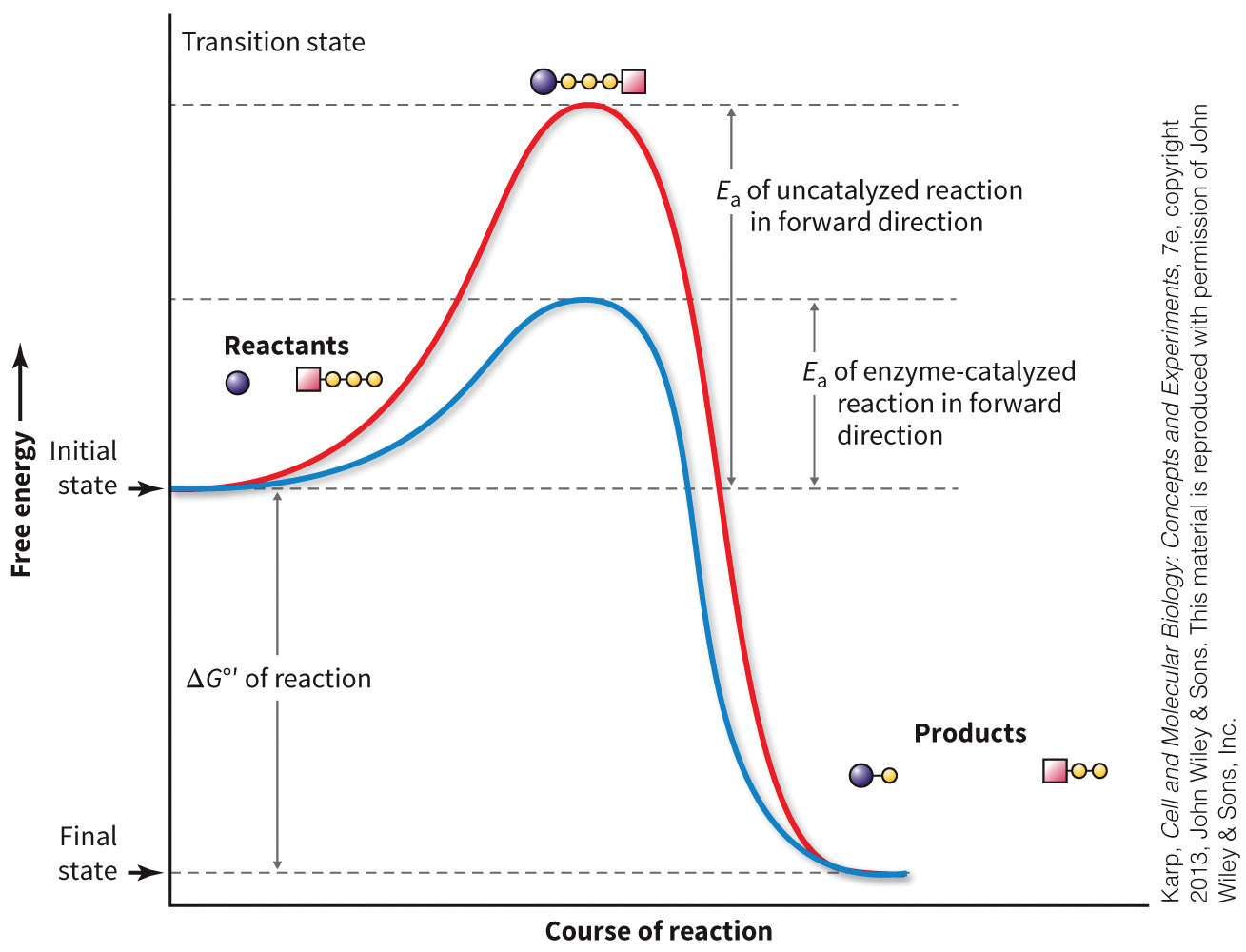
Enzyme Mechanism
Lowers activation energy (Ea) to speed up the reaction/increase reaction rate
Does not change thermodynamic parameters
Figure 4.5 Enzymes lower activation energy.
Section 4.2 Learning Objective
Examine the rates of enzymatically catalyzed reactions mathematically.
Michaelis–Menten Constant
For the reaction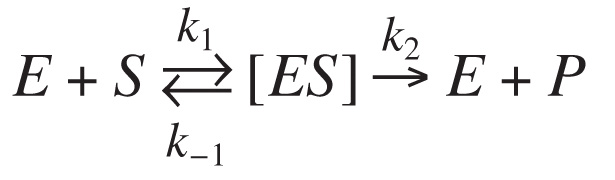

E = enzyme
S = substrate
ES = enzyme-substrate complex
P = products
V = velocity
Michaelis–Menten Equation
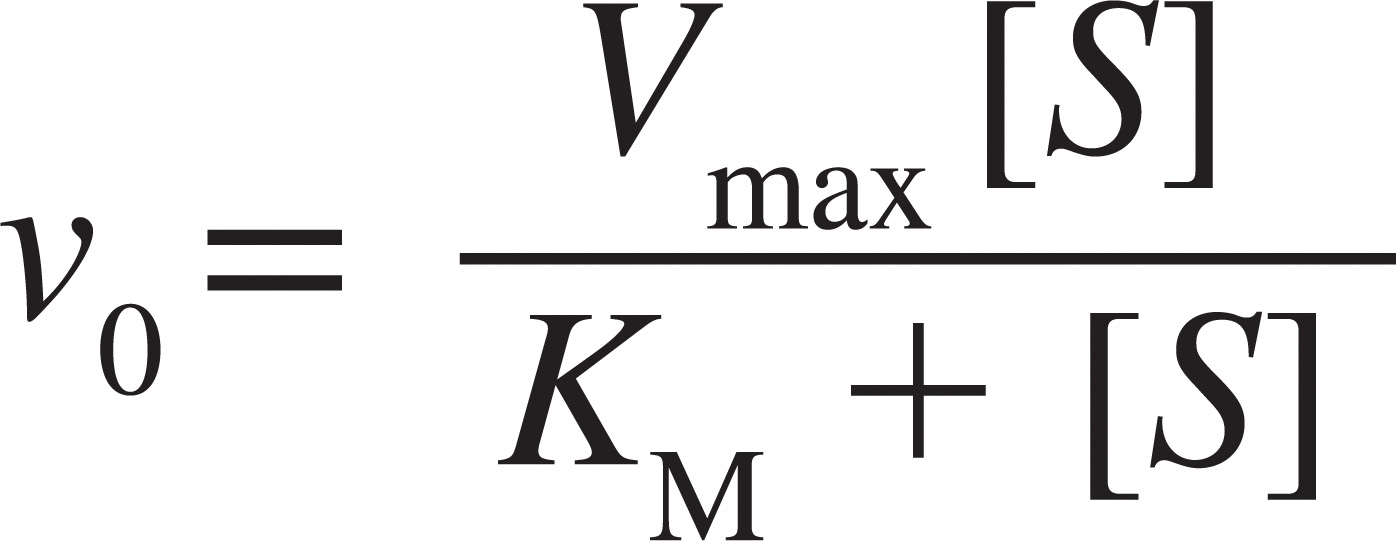
Vo = initial velocity
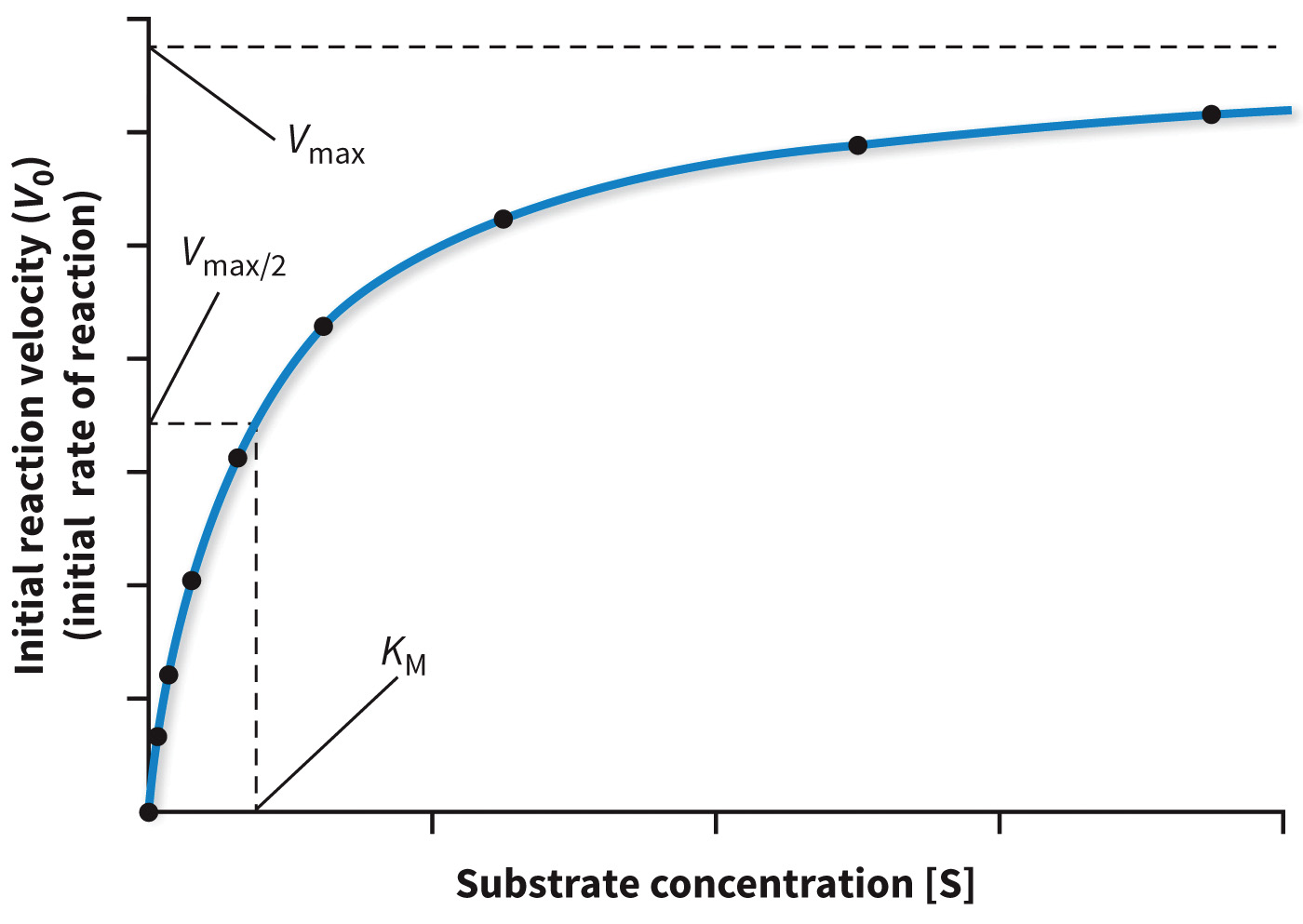
Saturation Kinetic Curve
If there is enough substrate, the enzyme will reach full saturation.
Figure 4.7 Saturation kinetic curve.
Lineweaver–Burke Plot
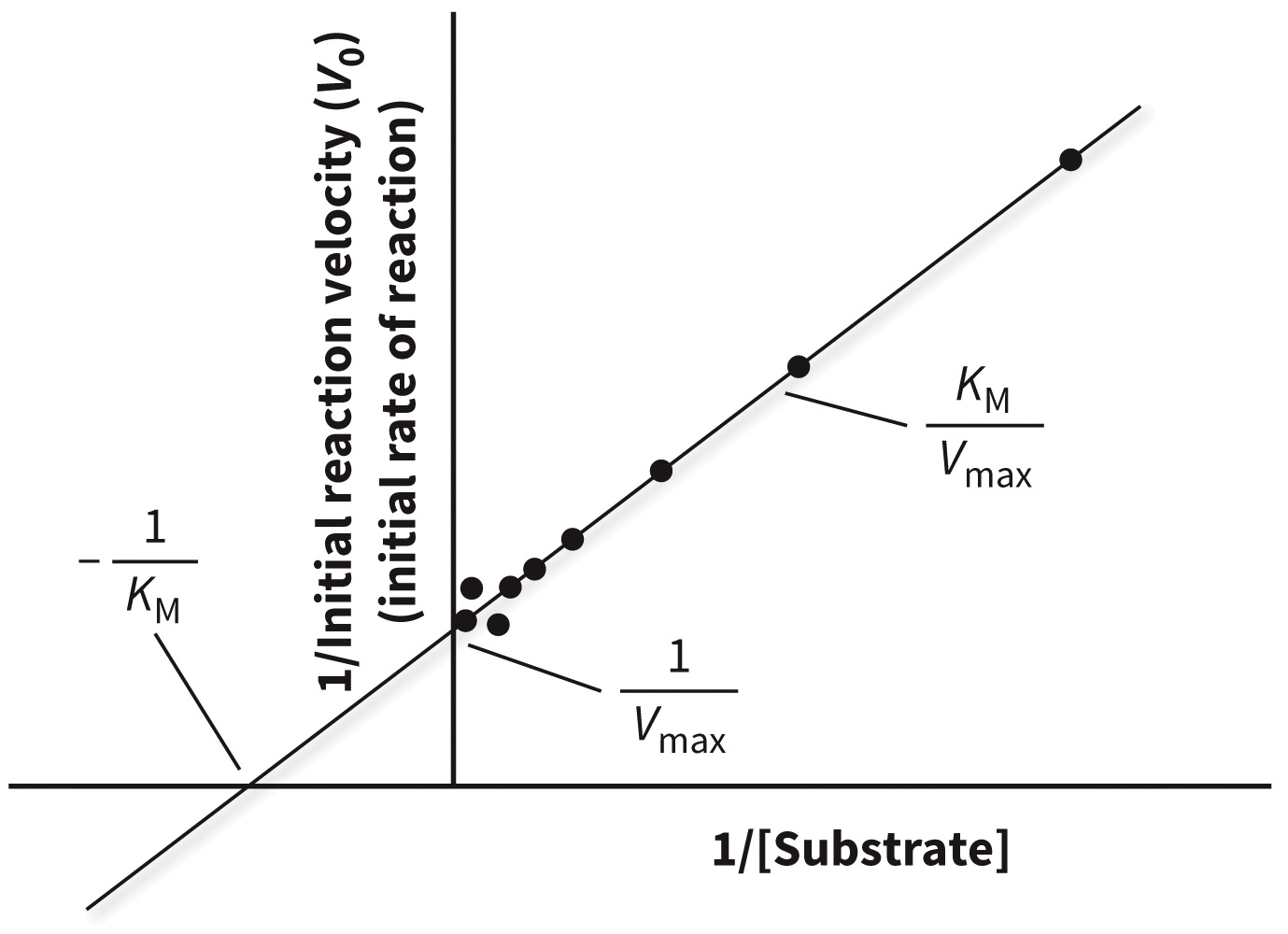
Double reciprocal of Michaelis–Menten equation
Easier method to interpret graphical data

y-intercept is 1/Vmax
x-intercept is –1/Km
Lineweaver–Burke Plot
Figure 4.8 Lineweaver–Burke plot.
Turnover Number Defined
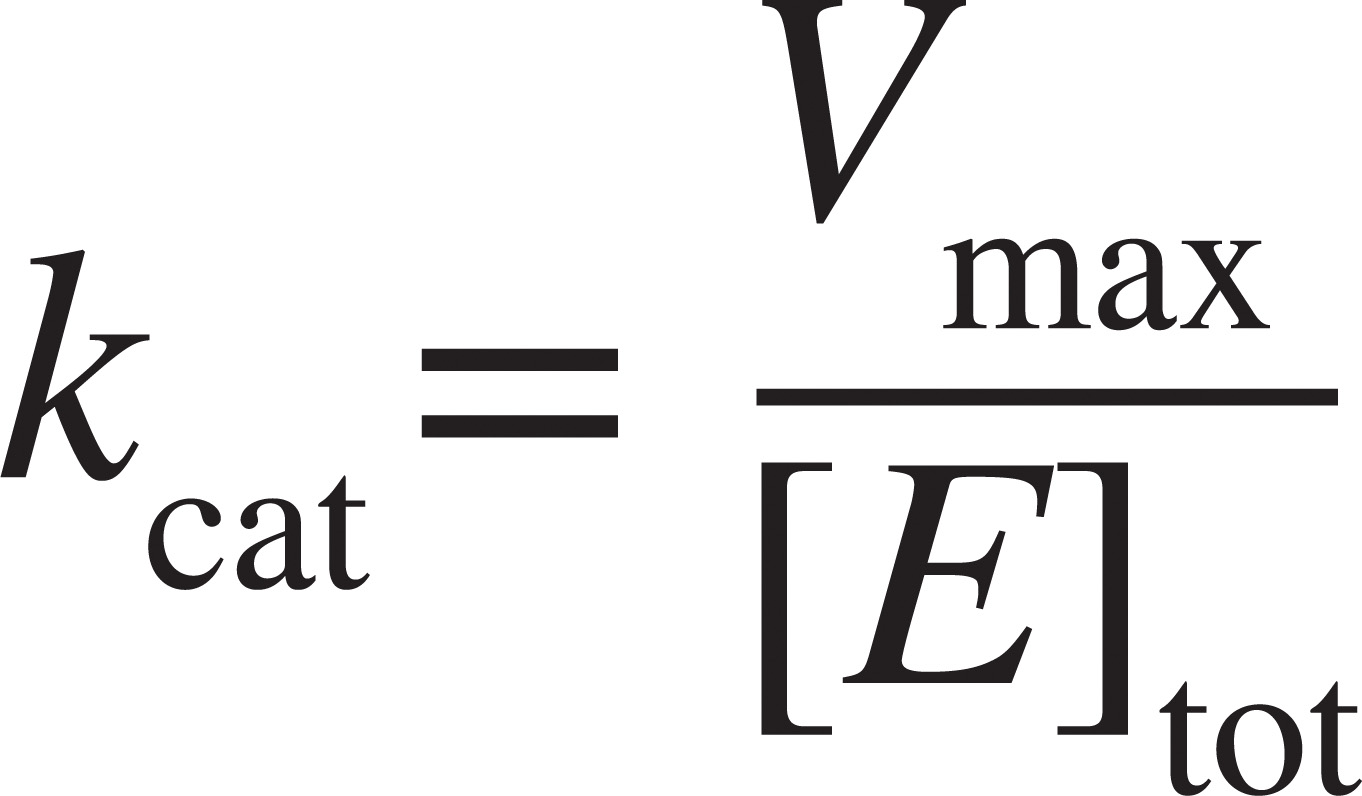
Turnover number (kcat) is the number of reactions the enzyme can catalyze per unit of time.
Can be used to measure catalytic efficiency, which describes how often a reaction occurs for every encounter of enzyme and substrate
Diffusion Controlled Limit Defined
Diffusion controlled limit is an occurrence when rate-limiting step becomes the diffusion of enzyme and substrate together.
The enzymes catalyze a reaction nearly every time they encounter a substrate.
The rate must be between
Inhibitors
Prevent the generation of products
Can be irreversible or reversible
Suicide Inhibitors Defined
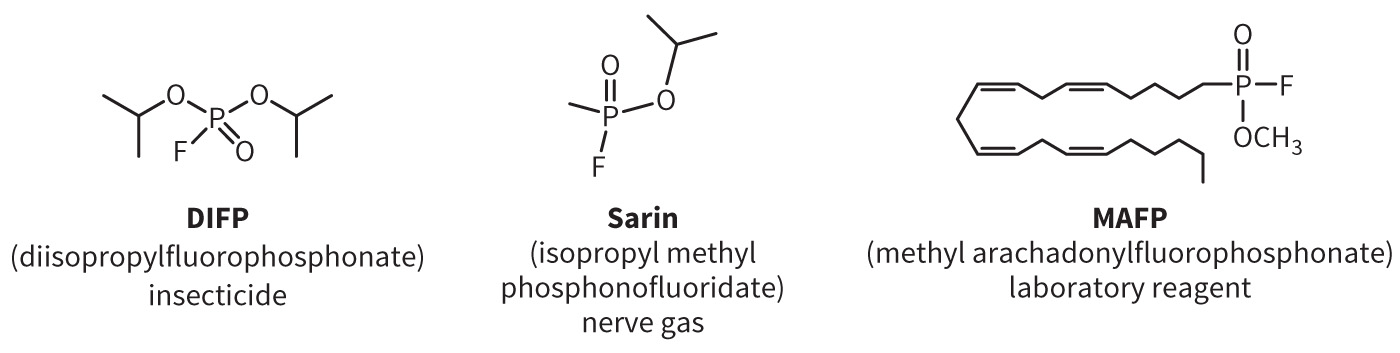
Suicide inhibitors directly poison the enzyme.
Covalently modify the active site of the enzyme, irreversibly blocking its function
Inactivate enzyme
Examples include pesticides and nerve agents.
Irreversible Enzyme Inhibitors
Figure 4.9 Irreversible enzyme inhibitors.
Competitive Inhibition
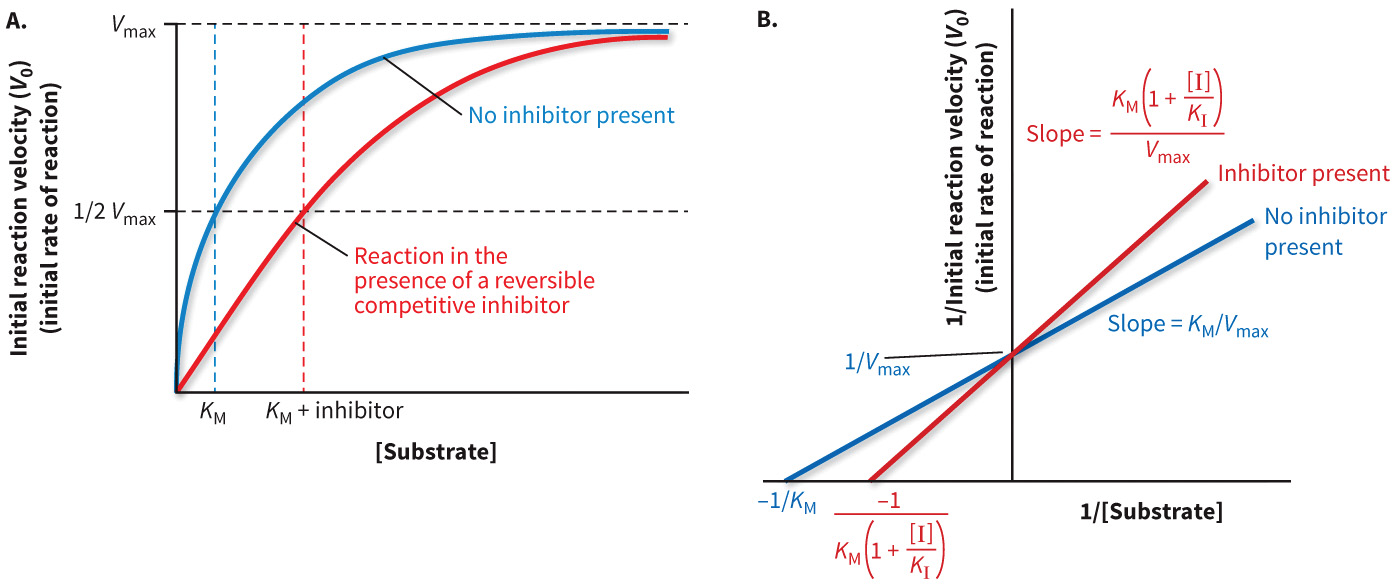
Recognizes molecules similar to the shape of the substrate that binds to the active site
Competes directly with the substrate
Can be overcome if the substrate concentration is high
Michaelis–Menten Equation for Competitive Inhibition
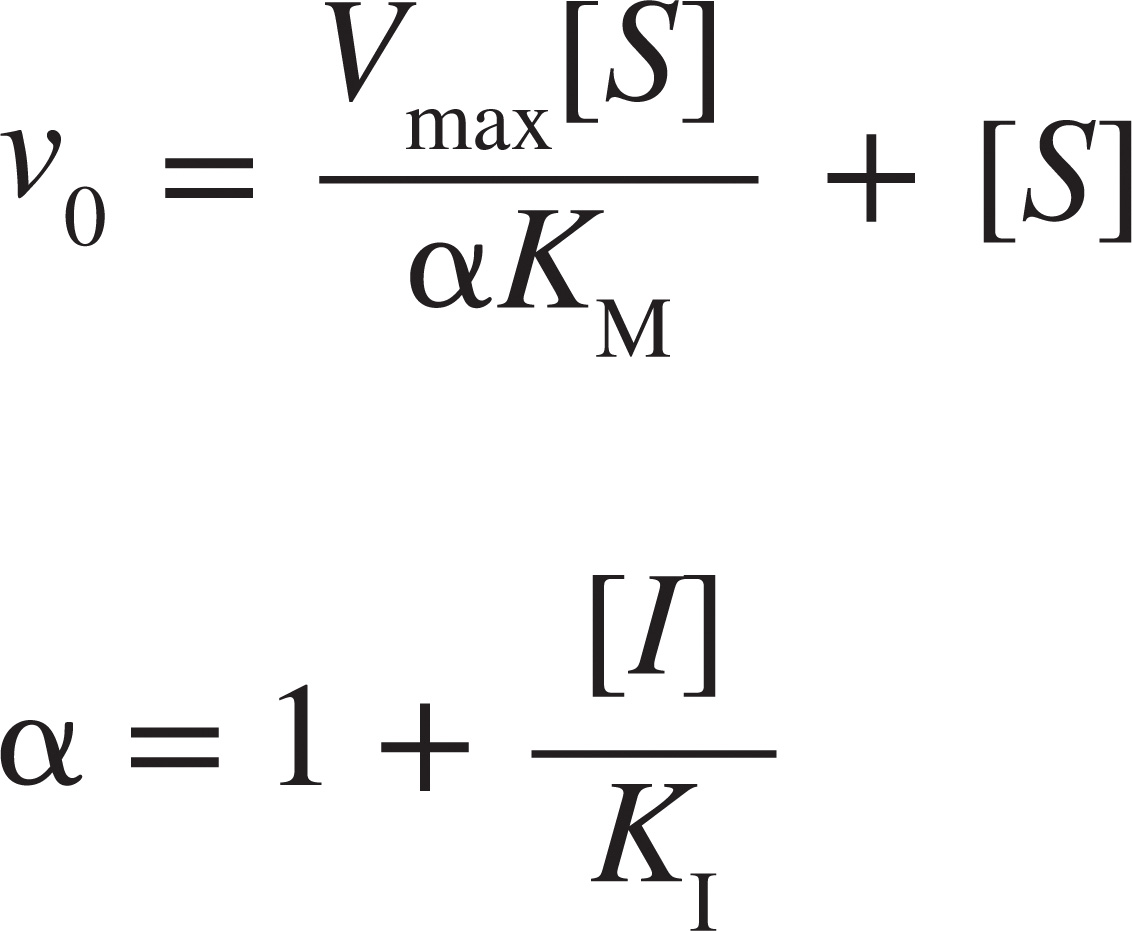
Ki = dissociation constant for EI complex
Competitive Enzyme Inhibitors
Figure 4.10 Competitive inhibition.
Uncompetitive Inhibition
Binds to the ES complex
Decreases Vmax
Increases KM
Michaelis–Menten Equation for Uncompetitive Inhibition
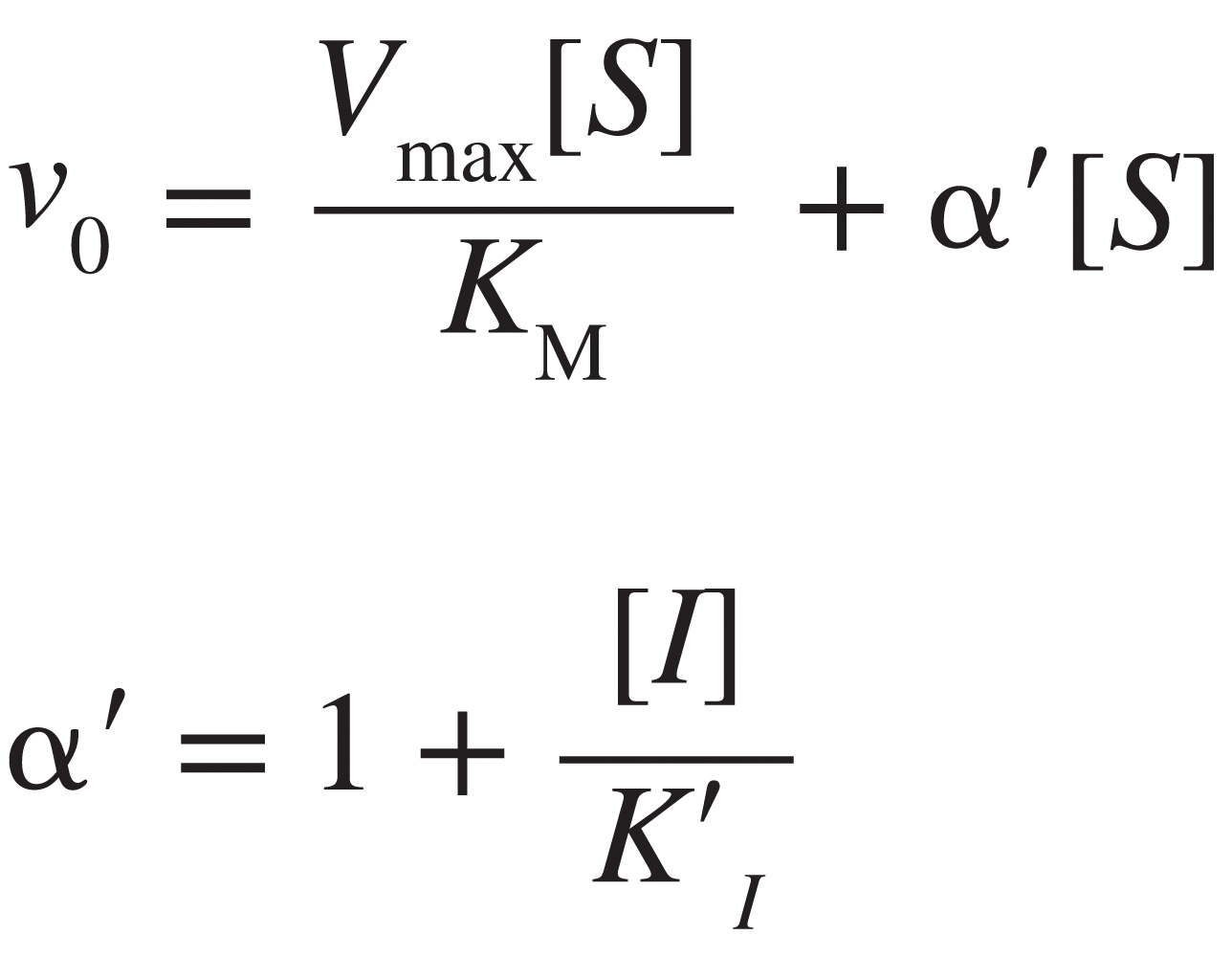
Ki = dissociation constant for ESI complex
Uncompetitive Inhibition Plots
Figure 4.11 Uncompetitive inhibition.

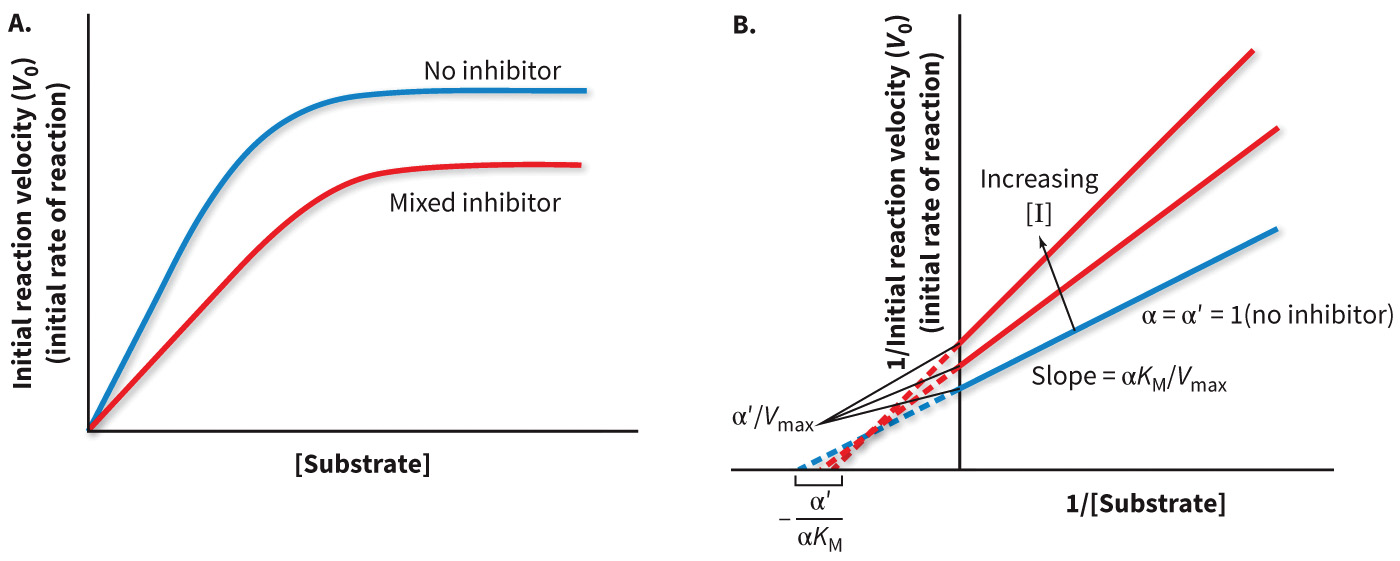
Mixed Inhibition
Bind in the presence or absence of substrate
A combination of competitive and uncompetitive inhibitors
Effective regardless of substrate concentration
Michaelis–Menten Equation for Mixed Inhibition

Ki = dissociation constant for ESI complex
Mixed Inhibition Plots
Figure 4.12 Mixed inhibition.
Summary of Inhibition
| Inhibitor | Apparent Km | Apparent Vmax |
|---|---|---|
| None | Km | Vmax |
| Competitive | αKm | Vmax |
| Uncompetitive | Km/α′ | Vmax/α′ |
| Mixed | αKm/α′ | Vmax/α′ |
Section 4.3 Learning Objective
Construct reaction mechanisms for enzymatically catalyzed reactions based on experimental data.
General Principles of Enzyme Catalyzed Reactions
Enzymes bind to substrates using weak forces and orient them for chemistry to occur.
Entropy is lowered.
In induced fit, the enzymes bind substrates that favor the transition state.
The use of weak forces is referred to as electrostatic catalysis
Section 4.4 Learning Objective
Compare the different means by which enzymes are regulated.
Types of Catalysis
General acid–base catalysis
- Amino acid side chains donate or accept protons.
- Polar and charged amino acids play important roles.
Metal ion catalysis - Active site metal can act as a redox active center.
Covalent catalysis - Nucleophilic or electrophilic attack on an atom results in a covalent intermediate.
- Involves Ser, Asp, Cys, Lys, Tyr, and several cofactors
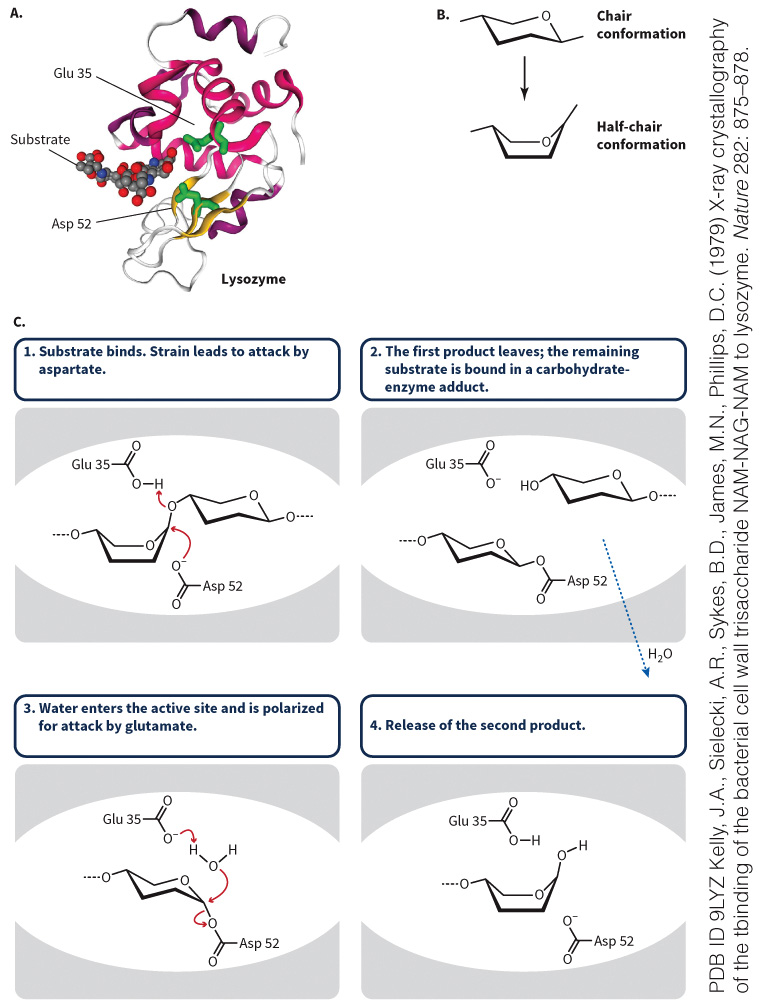
Lysozyme: An Example of Acid–Base Catalysis
A natural antibiotic
An enzyme found in egg whites, tears, and mucus
The active site contains two negatively charge residues
Glutamic acid is protonated, whereas aspartate is not
Oxonium intermediate is formed
Mechanism of Lysozyme
Figure 4.13 Mechanism of lysozyme.
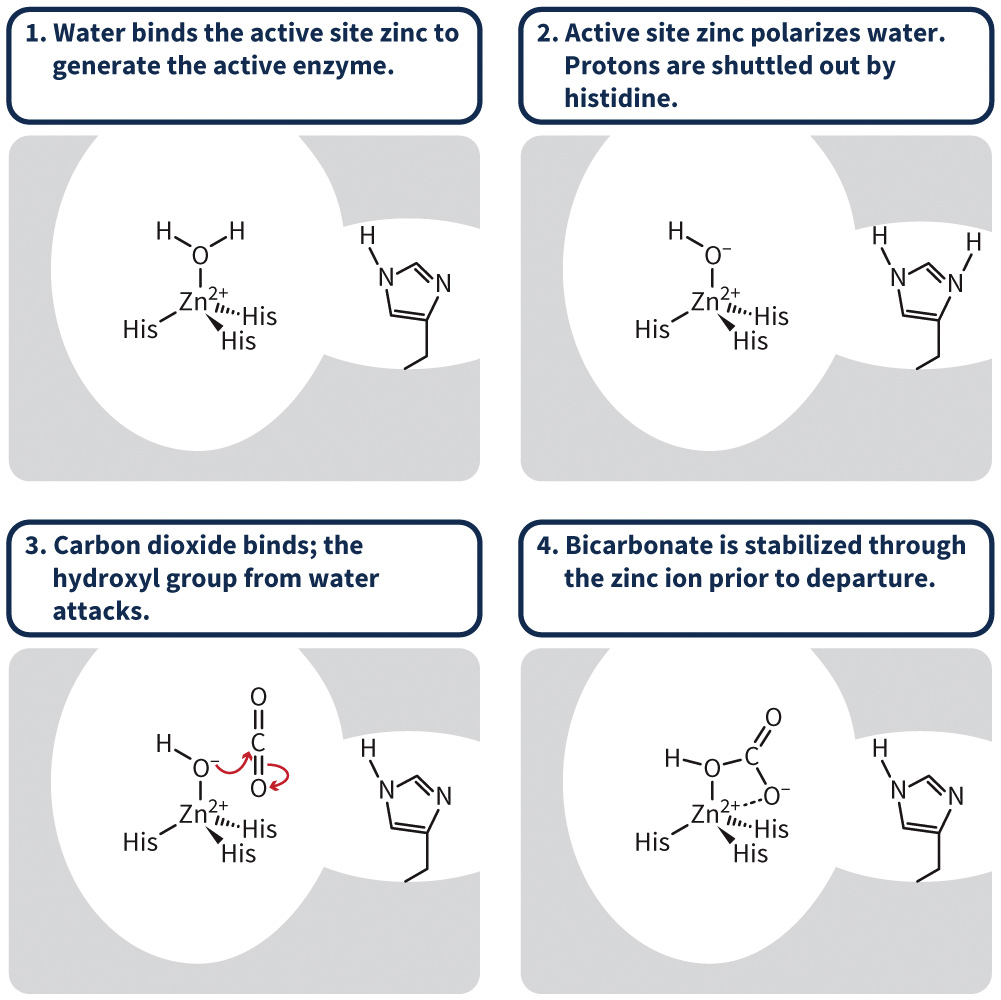
Anhydrase: An Example of Metal Ion Catalysis
Found in erythrocytes
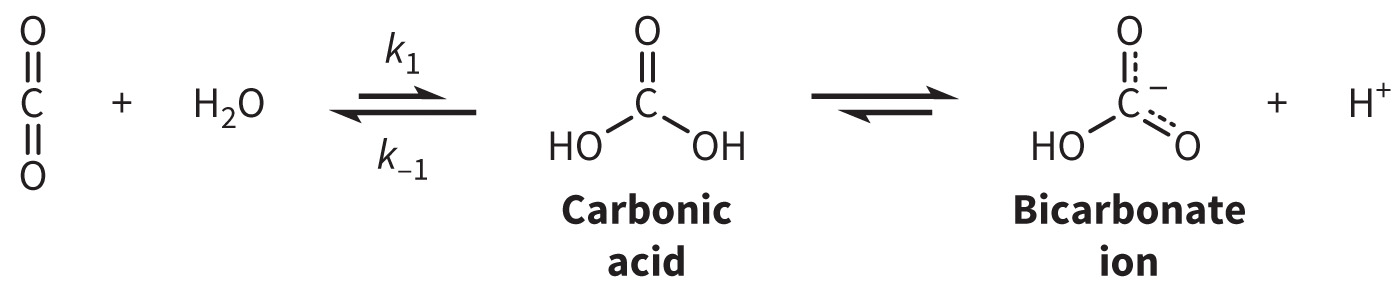
Catalyzes the conversion of carbon dioxide to carbonic acid
Zn2+ is in the active site.
His assists in shuttling out
Figure 4.14C Carbonic anhydrase structure and reaction.
Mechanism of Anhydrase
Figure 4.15 Mechanism of carbonic anhydrase.
Proteases Defined
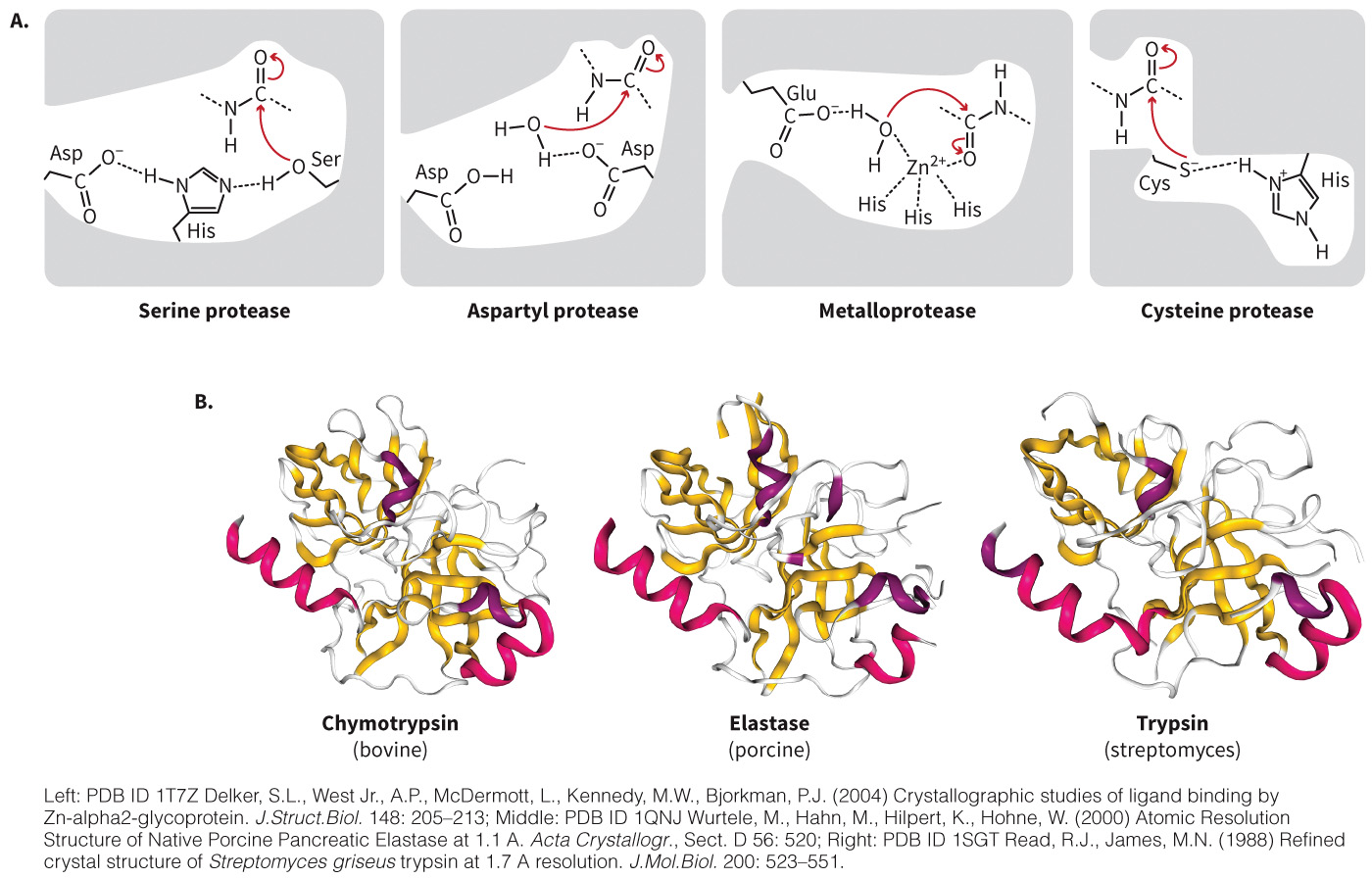
Proteases are enzymes that degrade proteins.
- Cleave peptide bonds
- Some are specific.
- Ser, Asp, and Cys proteases, metalloproteases
- Important in protein maturation, blood clotting, and protein trafficking
- Include chymotrypsin, trypsin, and elastase
Protease Examples
Figure 4.18 Different classes of proteases.
Chymotrypsin: An Example of Covalent Catalysis
Serine protease
Cleaves dietary protein on the C-terminus of Tyr, Phe, and Trp
Secreted from the pancreas
Contains a catalytic triad containing Asp, His, and Ser
Inactive form = chymotrypsinogen
Chymotrypsin Structure and Reaction
Figure 4.16 Chymotrypsin structure and reaction.

Chymotrypsin Mechanism
Nucleophilic attack
Tetrahedral oxyanion intermediate
Figure 4.17 Mechanism of chymotrypsin.

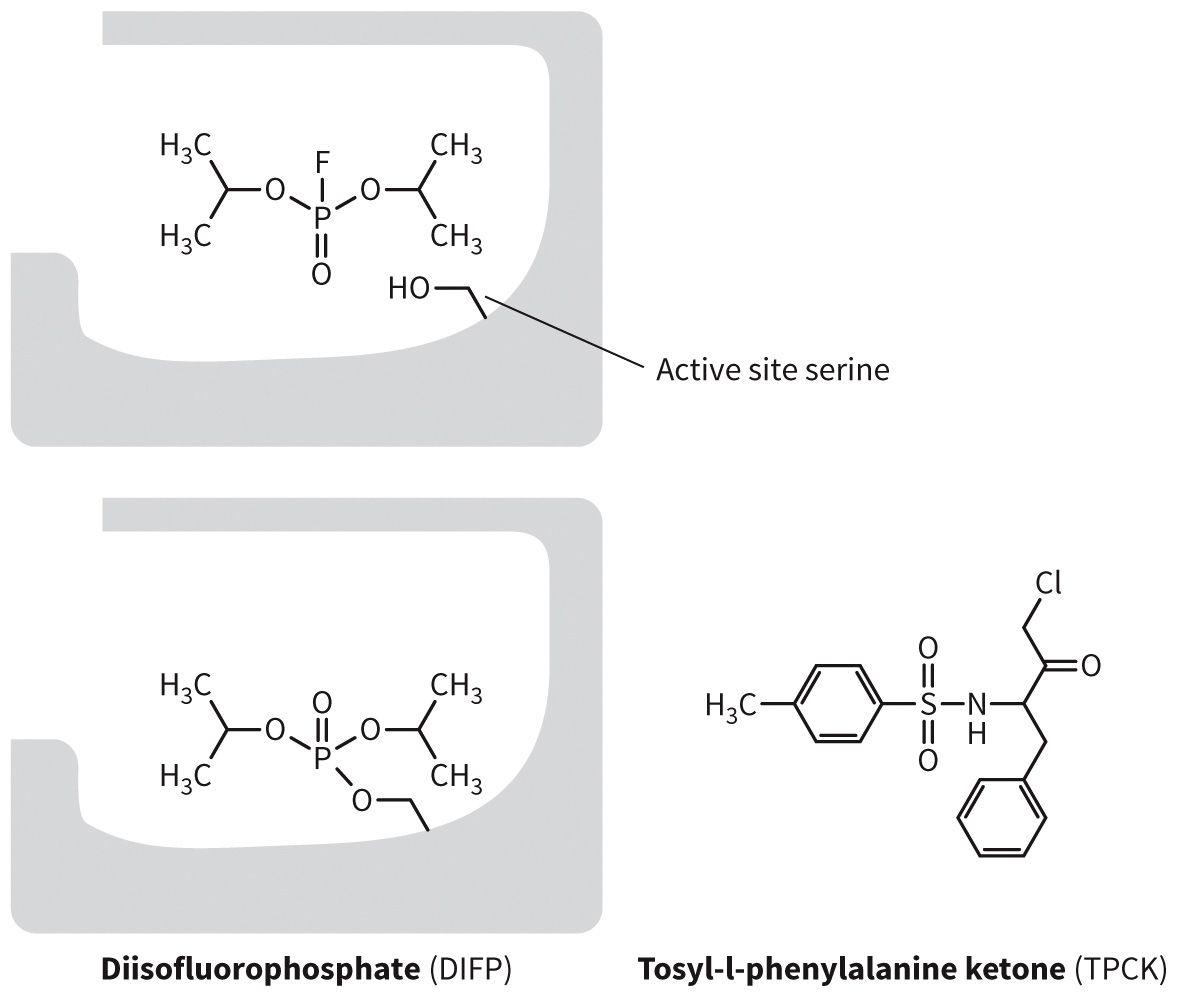
Affinity Labeling Defined
Affinity labeling is a technique used to specifically label residues on the active site.
Examples include:
- Diisopropylfluroidate (DIPF)—serine active site
- Tosyl-L-phenylalanine chloromethyl ketone (TPCK) —histidine active site
Labeling can be blocked by competitive inhibitors.
Affinity Labels
Figure 4.19 Affinity labels diisofluorophosphate (DIFP) and tosyl-L-phenylalanine ketone (TPCK)
Section 4.4 Learning Objective
Describe several examples that illustrate the diversity of protein structures and functions.
Enzyme Regulation
Activity can be regulated by altering gene expression
Sequestration of the enzyme in one compartment of the cells or one organ
Limit the access of the enzyme to the substrate
Methods include:
- Covalent modification
- Allosteric regulation
Covalent Modification Defined
Covalent modification is the covalent addition or removal of groups from proteins.
Zymogens Defined
Zymogens are inactive enzyme precursors that require proteolytic activation.
Chymotrypsinogen is the inactive form of chymotrypsin.
Proteolytic Cleavage Defined
Proteolytic cleavage is an example of enzyme activation.
An inactive enzyme becomes active through cleavage.
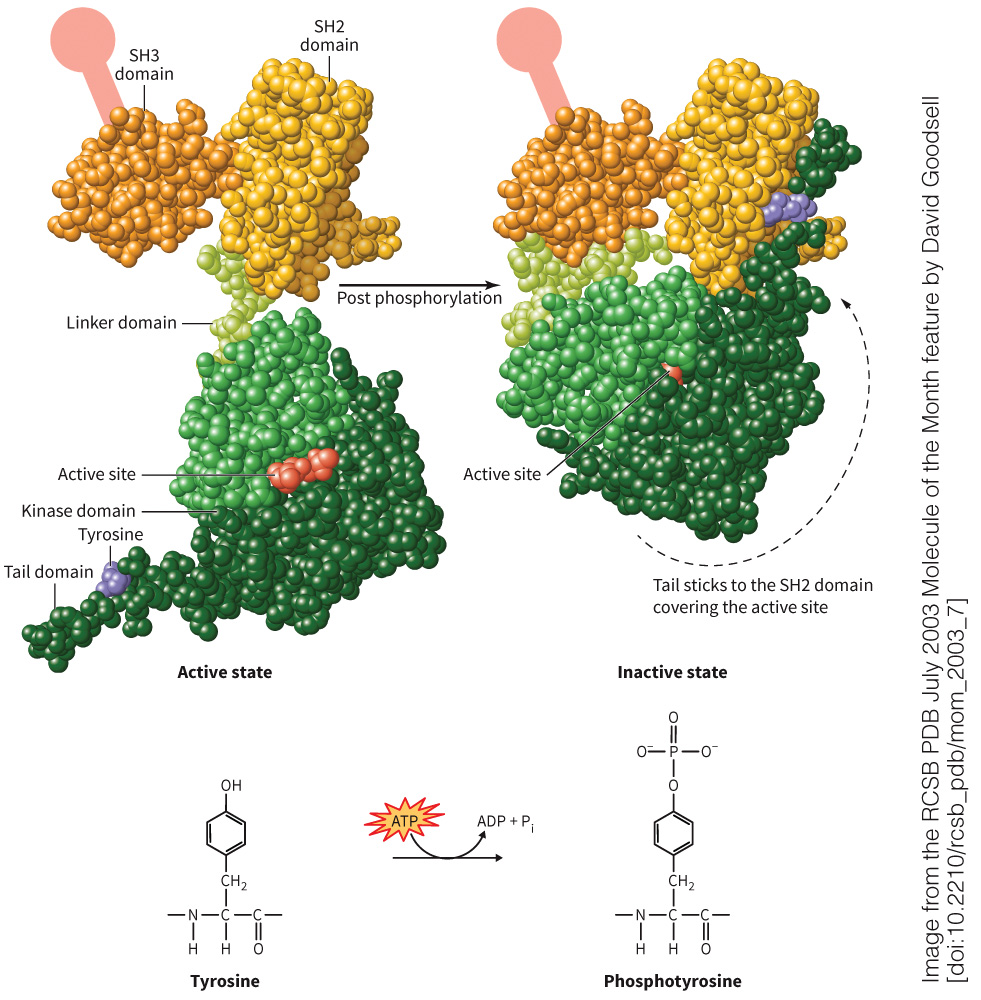
Phosphorylation
Another example of protein activation
Facilitated by protein kinases
Protein kinases add phosphate groups (from ATP donor)
Phosphatases remove phosphate groups
Acts like a switch
Src: An Example of Regulation via Phosphorylation
Figure 4.22 Src is regulated by phosphorylation.
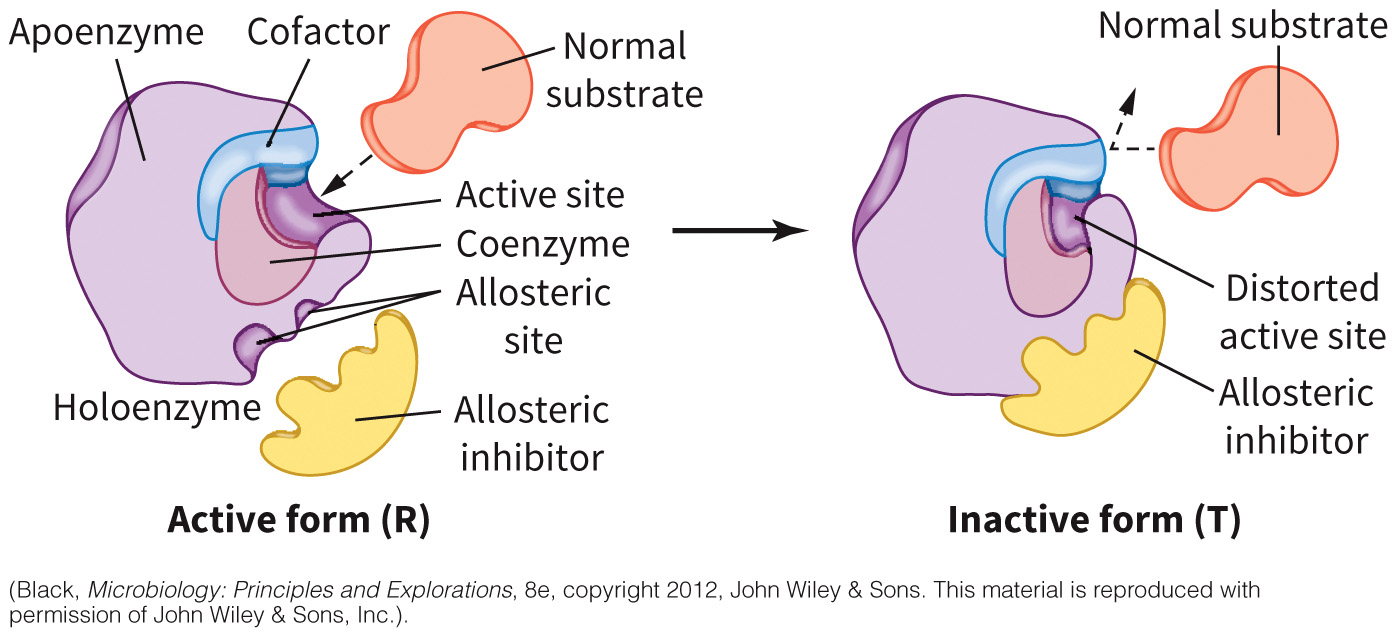
Allosteric Regulation
Increases or decreases the enzymatic activity by binding at a site other than the active site
Most rapid and most direct form of regulation
Allosteric regulators are typically small molecules and proteins.
Figure 4.23 Allosteric regulation
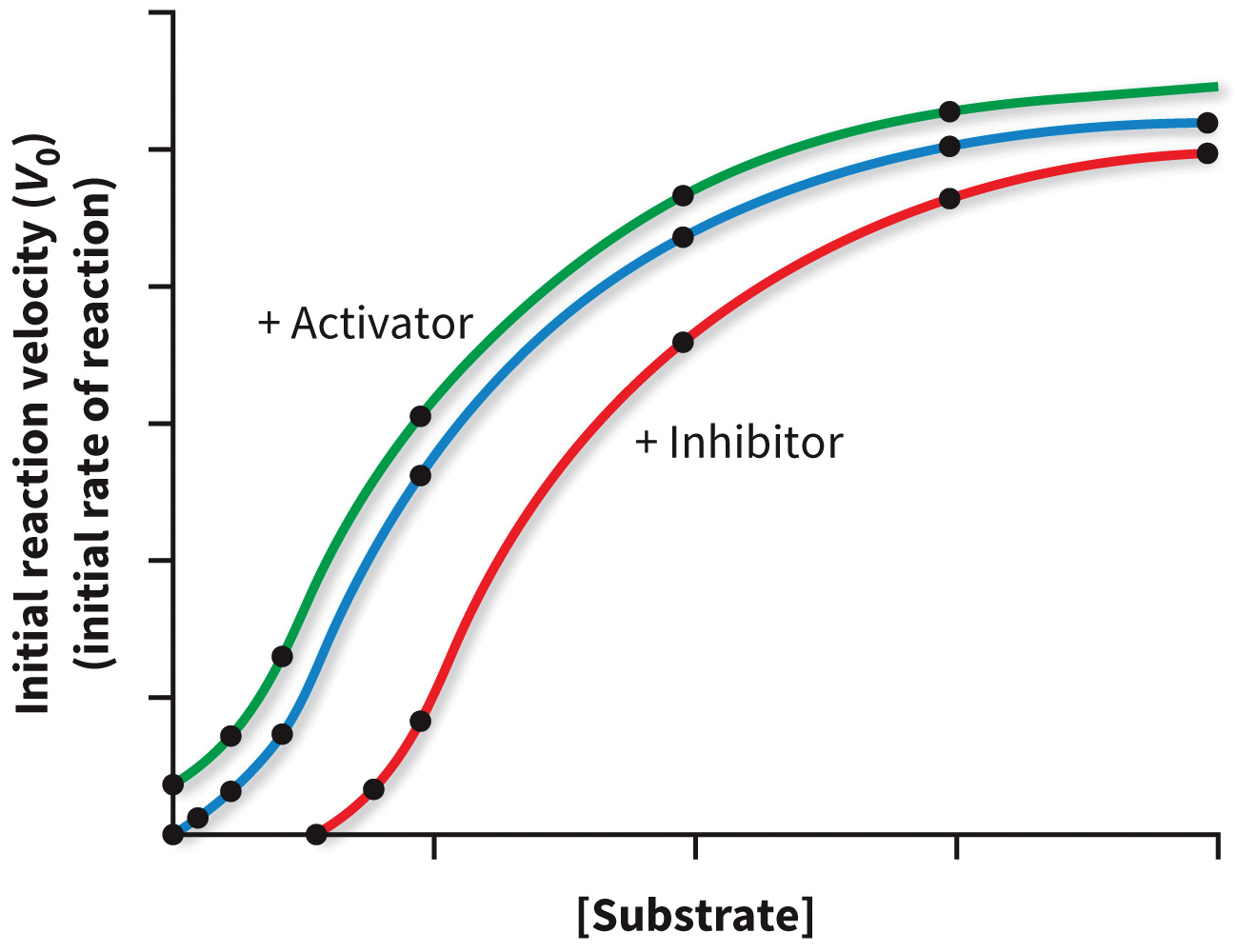
Allosteric Regulation Binding Curves
Figure 4.24 Allosteric enzymes have sigmoidal kinetics.
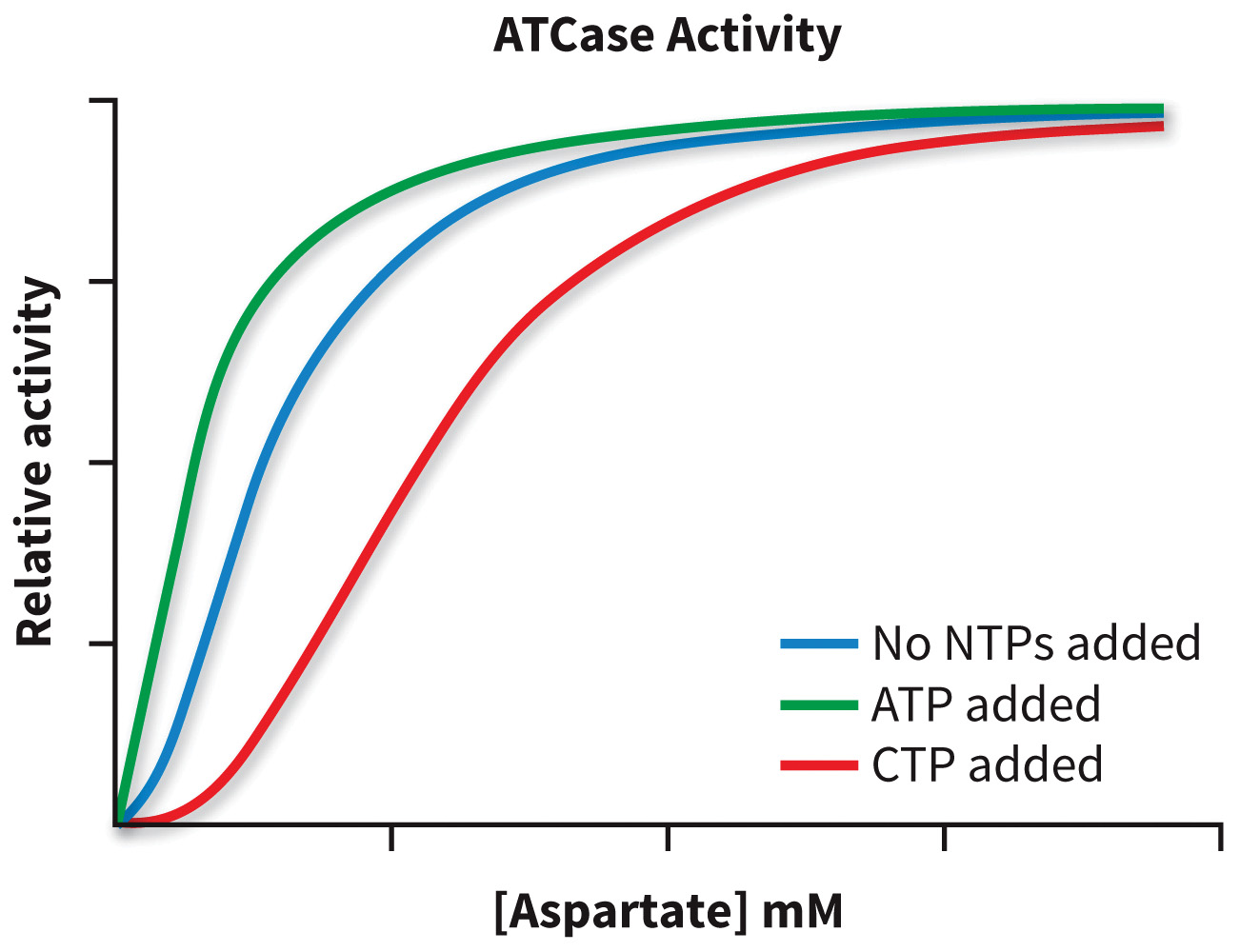
Aspartate Transcarbamolyase (ATCase): An Example of Allosteric Regulation
The rate-limiting step in pyrimidine biosynthesis
An example of feedback control
Regulators are ATP, CTP, and UTP
Figure 4.25 ATCase regulation.
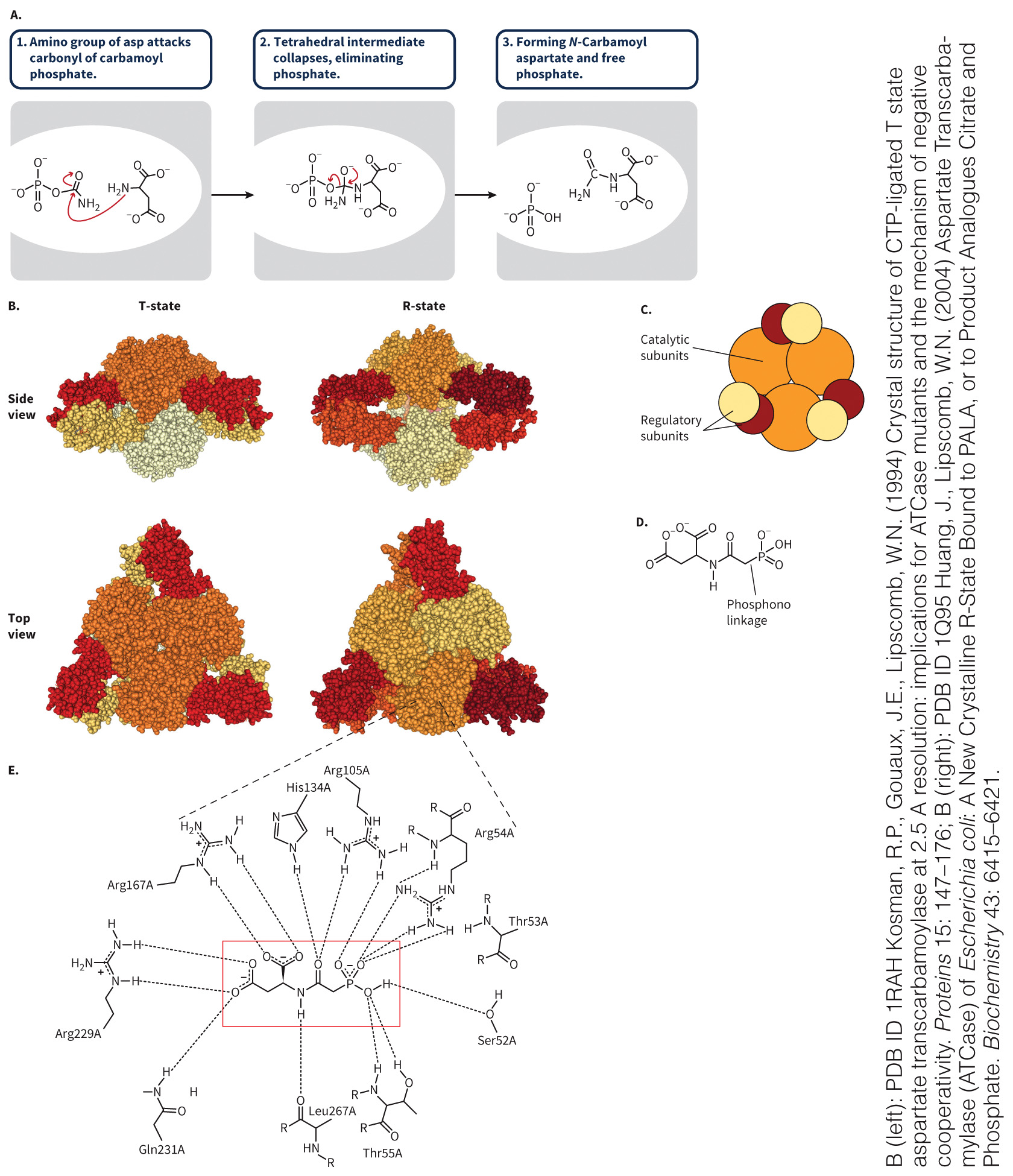
Allosteric Regulators on ATCase
Figure 4.26 Effect of allosteric regulators on ATCase.